MINTIKA

Showing posts with label Interviews. Show all posts

Saturday, July 16, 2011

Matt Noren of Tarboo


Tarboo
(206) 321-0597

What inspired you to start Tarboo?

We started Tarboo for quite a few different reasons it was a long conversation with Maikoiyo that we’d been having for about a year just about creating locally made garments, trying to rekindle garment culture, Seattle aesthetic looking at the Pacific Northwest as a place for style to begin with and then the timing was really right for us to jump onboard and do it.

What makes Tarboo different?

Tarboo has two main strains going for it. I think our aesthetic is very unique; we’ve come up with our own style between certain details in our shirt making such as rounded collars, patches or certain cuts. Then that mixed with how we produce I think the fact that we have a small boutique production model that’s completely in-house is different than how most companies do it

How do you see yourself growing?

Expanding the line a little bit, we’re really growing on the production side, so we can produce more garments, so we can produce them quicker. Looking at specific wholesale situations but getting Tarboo out there as much as we can. Right now we don’t do much wholesale but we’re looking at taking on much larger accounts.

I would love to start a Seattle mill, it would be awesome. I think logistically there is a lot that would have to come into play. I would love to see Seattle start making its own wools, denim and wovens, things like that. I think that would be phenomenal.

What do you think about the Cascadia concept?

Um…It’s fantasy it’s interesting, as a concept. It’s a question of what’s going to happen to these large national conglomerates. Does it make sense for 300,000,000 people to be wrapped up under one premise because I think if Cascadia was to happen it would have to happen all over, it couldn’t just be the United States and Cascadia it would be, the South, even the South would be broken up in specific ways, the Carolinas vs Virginia vs Florida vs Alabama they’re all very distinctly different places, then up north, the Dakotas, Montana and then the Midwest I think all that would have to happen simultaneously. I would be a fan of smaller nations I think it would be easier to manage.

Why are you partial to the Northwest?

It’s my birthplace, I grew up here. I think the people here are very fun. I like that Seattle is a place where you can really start things. You can really sink your heels in and find the resources you need and go after what you want, make some cool moves, make some things happen. I think Seattle really enjoys these things and has a culture that likes to support them and builds and keep them going.


Wednesday, June 22, 2011

Interview with Angela Holstrom of Frankie Four


Frankie Four Website
How to Buy From Frankie Four
Frankie Four Buy Olympia

How did it all start?

I once made a tie for a play and I thought I could make one that was more interesting. I started making ties out of whatever fabric I could get a hold of, a lot of it vintage inspired. I made one for my brother and boyfriend and soon people were asking for them. I started shopping them around to stores and began Angel Eyes Designs in 2004. This lead me to my next venture, I have always collected vintage stretch fabric from the 60s, 70s, 80s. I found many of these fabrics at thrift stores often from mumus and larger dresses. I had a shirt from the late 70s that I really liked and I decided to make a pattern from it. I started carrying them in stores in addition to my ties. I then decided to make it into a dress so I kept the same lines of the shirt and extended it to an A Line knee length dress and started selling these. I still had a huge amount of vintage fabric because I shopped every week and I thought, I better do something with it all. I have always loved vintage bathing suits but often they’re either just gross or the elastic is stretched out or they’re faded or uncomfortable. I made my first little 60s bikini for myself now I have a bathing suit line which includes three bikinis and two 1-pieces that I sell at the same stores I sell my ties, shirts and dresses.

I currently sell to four stores, two in Seattle one in Queens, NY and online at Buy Olympia (only ties). I have not figured out how to sell my shirts, dresses or bathing suits online, the unique fabrics and stretches cause each piece to fit differently, especially the bathing suits. I am currently starting to talk to a store in Santa Barbara about carrying my bathing suits, which is fun. I have recently decided to change the name of my business to Frankie Four, I never liked Angel Eyes because it sounded too cutesy and I wanted something more masculine for the men. The name Frankie Four is family inspired, my two grandpas and dad are named Frank and my brother is Frankie. It’s great because I’m making men’s swim trunks now, they are 60s inspired and slim fitting because men’s trunks right now are baggy or tight like speedos and my trunks are somewhere in between. They’re made of my thicker stretch fabric so they have a give to them, they’re comfortable.

Favorite Decade?

I love the 50s and 60s and I think mostly because my body comes from that era. I gravitated to the fit of the 50s, the smaller waist and the fuller skirts. I love all the colorful, bold and bright prints from the 60’s and 70s. The dress I make is a little more modern, I don’t think it fits a certain era though. The fabric is vintage so it’s a mix of vintage and modern and a lot of different types of people can wear them.

Favorite Designers?

Honestly I don’t really follow up on a lot of designers. Everything I started making besides ties is something that I made for myself first. I liked them and people started asking for them so I started making them. My designs have been based on things that I’ve liked not what the trend is at the moment. I do love old musicals though. I grew up watching Fred Astaire and Ginger Rogers. Singing In The Rain is one of my favorite movies. I love Marilyn Monroe she was a huge inspiration for my bathing suits, I love designing for a curvier figure because I feel it’s more realistic. Gidget is the movie that inspired me to make men’s trunks.

Would you ever move anywhere else?

I have considered it but I feel since I’m mostly just in my studio alone creating a part of me wants to live in a country home by the river. Probably in the northwest but I know Seattle is not great for fabrics, then again I source my fabric mostly form thrift stores. I want to move to Hawaii and set up in a little shop. Maybe my husband will play the ukulele in a hotel for a while. We went to Hawaii before we were married and when we came back he put out a Hawaiian album. We are both kind of obsessed with Hawaii. I love the tropical weather..I’m from Southern California. As I get older and live here longer I am realizing I want to be in a warmer place, a sunnier place and it would be better for my swimwear line of course. I mean they started selling in April but come August it’s over. If I do get them into this little shop in Santa Barbara that would be exciting. My biggest fear since all my fabric is vintage is not being able to find it anymore.
I think the reason I started making my dresses was because I can’t help but buy anything with a cool pattern, shapeless mumus mostly. Since I had all that fabric I wanted to make something that was flattering on the body. Now I can keep buying and know that it is going to be made into something, maybe a little bikini or a shirt...I’m no longer just collecting junk.
Recently I needed to fill in some holes in my fabric wall and usually when I go to thrift stores I only find one piece or I don’t find anything but this time I got a whole trunk load of vintage fabrics, yards and yards. So I’ve washed it all its now stacked on my dining room table and I’m thinking, where is it going to go? I also got the cutest bikini top because I’ve been wanting to make a new style of suit top, at the moment I only have two, maybe a triangle style? I think this suit is from the 80s, aqua and hot pink stripes and the bottom is high waisted but with ties so it scrunches to a low waist. I wanted to cut it up for a pattern but now I want to wear it.

When do you wear bathing suits?

When I went to Hawaii I brought six bathing suits. I go to California every summer and winter and Jason’s parent live in Portland and have a heated pool, any chance i get to get into a pool or a hot tub I take it. That will be the next thing we get at our house hopefully, a hot tub.

Expansion?

On the one hand I love how hands-on my line is, I make everything. On the other hand if I want ten more stores I might have to hire someone to sew for me. I never wanted to own my own store because I feel that would just get into the whole business side and I’m not a business person so I’ve never wanted a storefront I just love giving my stuff to stores. I’m a behind-the-scenes-shy-introvert. At the same time I don’t know if I can sew everything for all those stores so maybe I’ll have to hire people. At one time I thought I would mass produce my ties and get them into Urban Outfitters...maybe I’ll do that. I do think that every piece I make is a little work of art because it’s one of a kind so it’s hard to think of getting it mass produced but I might need to if I want to make a living. I also want to make them affordable for my peers. I don’t want my suits to be $300, would be nice but it’s not worth it. I never thought I’d be making ties for so many years but they sell...I collect a lot of non stretchy vintage fabrics so I have cool cottons and I’m thinking of making 50s style sundresses. Last year I made four hoodies...living in Seattle it kind of makes sense. I think in a few years it might shift from what I’m actually doing at the moment.

Thanks Angela!

Sunday, May 22, 2011

scenic drive e. pike factory


Scenic Drive E Pike Factory

A Conversation with Nikki Mazzei and Rachel Ravitch

What inspired you to open Scenic Drive

N: The common thread of the chorus is creating a space where people are welcomed to come in and feel inspired and connect with other people in our neighborhood and people who are designers and artists. Bridging the gap. There are so many reasons why people don’t know each other and it’s so simple in a way. To just learn things and not have to spend a ton of money taking classes, you could just meet up with people who are willing to share we kinda all feed off of each other.

R:And it’s amazing too like, the people that we’ve met Dawn, Matt and all these different designers and creative people everyone wants to create this community of where the culture is sharing what you know with other people instead of keeping it secretive “Oh no, this is my knowledge, I had to pay to learn this and I had to spend all this time…” it’s sort of a new trend in business in general and it’s really inspiring.


The collective/cooperative vs. the competitive/collective model?


R: No, yeah, basically the corporate/competitive model doesn’t really serve anybody except for the people at the very top and even those people it’s not really serving because none of them are really happy. The more cooperative method is about knowledge sharing and it’s driven by inspiration and happiness (laughs) as opposed to fitting into somebody’s bottom line. Cooperation creates a more community minded spirit, so it’s part of that trickle down effect, hopefully.


N: I think that part of it is too is that there is such a teaching/learning aspect to what we’re doing and because of the economy and everything else people are more pro learning and teaching. Figuring out how to do things for themselves. Whereas the corporate world is so “Go to Costco! Go to College you need to get a job! You need to buy a house! you know you need to do all these things and all the sudden you become dependent on everything that has to do with money.


R: People now who have been professionals like Dawn and myself, we went to college to do this specific skill set, to fulfill that but then when you’re ripped out of that or you choose to not be a part of it anymore it’s like well what does that knowledge mean and how can I express it differently and share it with people around me as opposed to just keeping it to myself .


What is your future vision for Scenic Drive, projects, dreams, fantasies?


R: I think that the one thing that is lacking and why independent designers can’t continue to make it on their own past a certain point is because it’s difficult to produce to the level they need to, to make it worthwhile in that same way. When you get to that production level it usually means that you’ve given your design away to somebody else to produce it in a sense, but there are other models we can look at that survived for a long time, I heard recently that Filson sold out to Ralph Lauren, but for a long time that was a company that made everything in Seattle, they made their own fabric they made everything, the quality of the materials hadn’t changed much in the last 100 years, it’s was all their signature stuff and by doing that they’ve been able to maintain a really true brand. But independent designers that we know will come to this point where they have to invest in all these different machines like they have to invest in a certain type of machine to make a button hole to put a button on and to put a zipper in jeans for example and if we can collectively create a cooperative production facility where we make the textiles and all the way to the finished product, basically it would be a facility where people can come and work on their own projects. A space where different designers could come and use all the machines and not everybody have to have every single one of those machines themselves. When you’re sharing with many different designers there is an integrity inherent to it’s existence that can’t be changed. And with this we’re creating a whole economy an economy that doesn’t exist anymore in Seattle. But there are definitely people that know how to sew, there is a whole program at Seattle Central…people graduate from there. The infrastructure is here to create that kind of industry and I think it’s really important to start making more industry like that in America if we want to survive.


Are there other people or organizations doing this?


R: There might be, like. It’s weird when you go to Barney’s or whatever what people think of as a luxury item is made like in Italy or France but there is no reason why we can’t be making luxury items here.

N: Craft is still really valued there in those countries, they value their craftsmen. They value buying something that costs a lot of money that took a lot of time with a lot of precision and maybe only five hands have touched it. But people here say they can’t afford that or what’s the point when they can just go to H&M and buy something for $19.99. I think also too is our vision is of creating a marker’s space for the general public and nurturing that teaching/learning aspect of what we’re doing because I think that’s really important, helping kids learn how to do things, teaching people how to use the letterpress and typewriters, I would really love to have a space that is 10 times the size of this space and we could just have every gadget you can imagine and workshops on how to use them.


Do you think alternative/local economies will eventually eclipse the global economies if so how?


R: I don’t know, I mean, it’s hard to say it’s like a dream almost…I hope so. Unfortunately our country has really invested itself in corporatism all the trade towers you see downtown are representative of that, if we start to have a more local economy what will happen to all those buildings? So there as basically been all this growth since the 70s that makes it less feasible, I mean who is going to take over that tower, cities are not going to let that go. They’ve invested in an entire city block being taken over and getting that tax revenue whereas European cities have commercial centers but they kept all of their downtown intact and built their urban center kind of away from downtown and so it’s not as important to them as keeping the integrity of our city intact. I think in some smaller ways and even in spite of itself the growth that has happened it’s kind of buckling back on itself, like Costco and malls are going to be obsolete because you have Amazon Fresh and businesses like that are emerging where you can buy dozens of rolls of toilet paper and have it delivered to you fucking door, you don’t have to drive there, the cost is slightly more expensive than buying it from Costco but the expense of driving, people are going to have to start thinking about that, when gas reaches $5 a gallon which will happen this summer people are going to start considering that and factoring that in. The delivery service is not really going to be that affected by the gas prices going up because they’re making the rounds regardless.

N: You can look at other countries, China, I think, they’re focusing on manufacturing things for themselves


R: Like France and Britain, they drive cars that are not manufactured to be exported they drive. They see a real value in that.


How do you think small businesses like yours will help reverse the global economic trend?


R: Creating a more pedestrian friendly city which is what small businesses do already something that helps fight that, it makes the city more vibrant. If we weren’t on this block there would no other business other than a coffee shop that would be inviting people to come in and do something.


N: There are so many empty buildings in this neighborhood that can be used to make it more vibrant and make it so much better. Basically a business that is good for the neighborhood not another Real Estate office or another Hair Salon but something that adds to the riches of what Seattle is supposed to be about, not another deep tunnel or another empty building that some developer owns and they’re just letting it rot.


Tell us about your monthly indoor market


Once a month we host a monthly indoor market featuring local art, craft and vintage. Featured artists/vendors include: Laura Vandecrimp (Vandecrimp Industries), Isabella Vicenza, Pamela Davis (Mucho Designs), Barbara Pronsato (Mintika), Maggie Schneider, Mark Ferrin (the hero thing machine), Izzie Klingels (Les Yeux D'Extase), Kook Teflon (Formerly Miss Oblivious), Cairo, 20/20 Cycles, and Scenic Drive.

Why is Native Funk and Flash so amazing?


R: Talk about local people doing things for themselves, that book is pretty inspiring. They have a little community that is supporting them and they’re like look at this person that what they’re doing is valuable, though it’s weird and they’re cuddling a doll under their blanket with little braids. It’s just unbelievable that that happened, that whole time period happened in the 60’s and 70’s were expressing themselves creatively and doing interesting things that completely contradicted what had been going on, you look at the 50’s and 60’s and that is when the whole push to use your automobile to go to the mall and drive up windows and all that bullshit and people like that were reacting to that and somehow…it didn’t change though, society didn’t change it just went right back to the way that it was I mean it kept going on that path.


N: Expressing themselves freely without any inhibitions, ‘This is who I am and and this is what I’m into’. They were reacting to standardization, where it’s just like Native Funk and Flash is just like not Standard, our shop is not Standard but it’s so rich and amazing


Dark or Milk Chocolate:

N: Both

R: Dark


Walk or Bike:

N:Both

R: Both


Beach or Mountains

Both


Creamy or Chunky

Both


Beer or Cocktails?

Yes, please

Wednesday, May 4, 2011

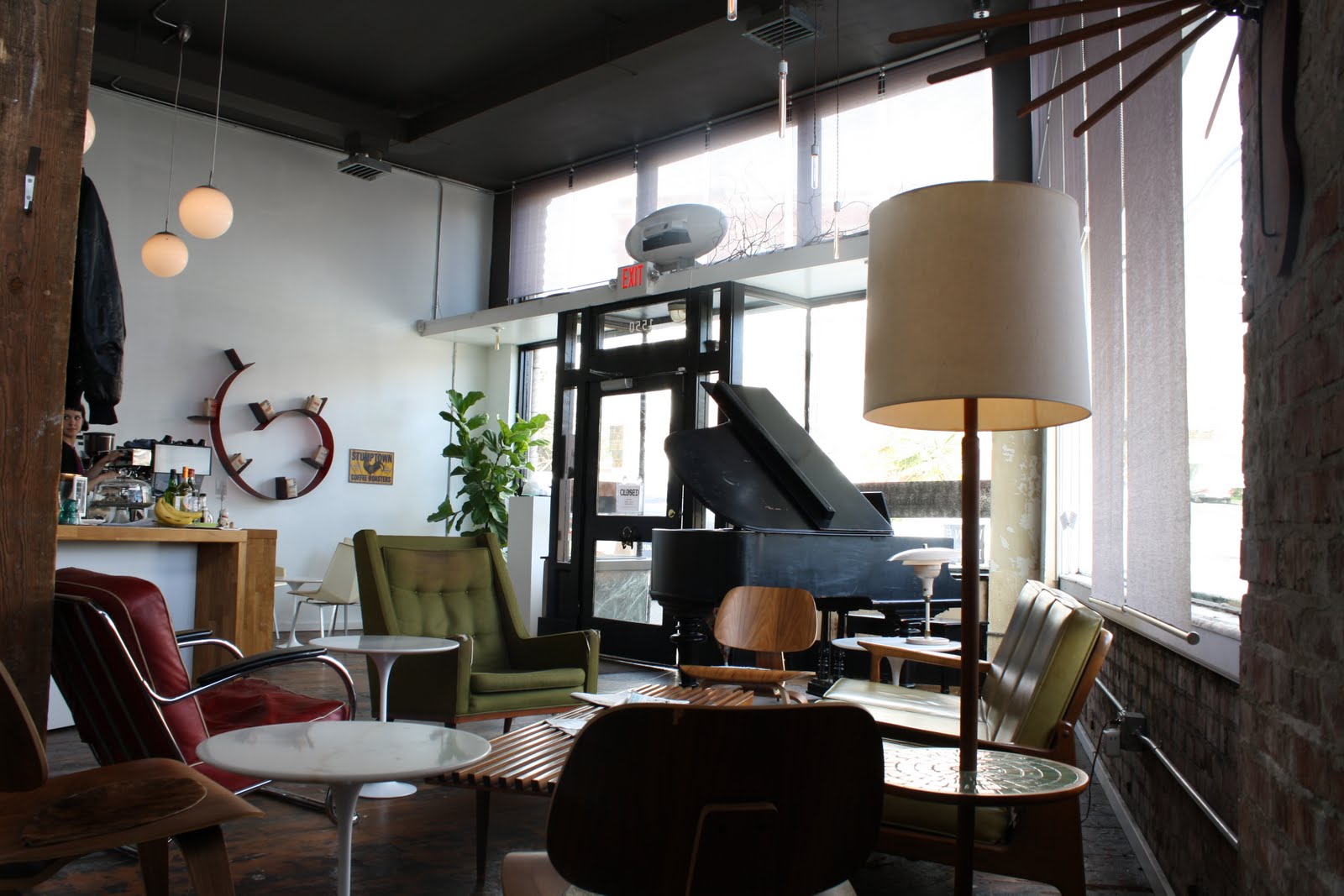
Interview with Jojo Corväiá of Arabica Lounge


Arabica Lounge

1550 E Olive Way

Seattle, WA 98102

Facebook

Map


What inspired you to open such a beautiful cafe in Seattle?


I always wanted to do something with food and drinks, and the loss of my family (partner and son) triggered this situation. I was doing art direction for commercial photography for over 20 years and decided to change careers for something I feel very passioned about. It is also a survival thing, a business that connects me with interesting people every day, with decision making, challenges... also with art, beauty, and most important, human interaction.


What drew you to the Northwest and where do you hail from?


I was living in South Florida before... not my cup of tea.


What is your culinary history, where did you learn to bake like that?


I'm not trained in any culinary school. I just like it, and I guess this is just the reflexion of my own taste


The furniture, did you shop for years or did you go on a shopping spree?


The furniture is actually the furniture of my house. I have had it for years, now it's being shared with strangers every day.


Who are your favorite designers/artists/musicians?


that is a very complex question. I may have way too many references to mention.


What has been Arabica's most popular food item?


As I anticipated, the "Luchador Cake", "Soldier's Eggs", "Anything with Salmon", and our "Vegan zucchini bread"


Do you have aspirations to open a restaurant some day?


I would like to see Arabica grow first... and eventually will expand but not as a chain of Arabicas. Arabica is a life style, so maybe the next Arabica will be a hotel, a laundry bar, or a general store...


Is the accent on the A or the i?


on the "a". Arabica is the type of coffee beans we serve. They are original from Ethiopia.


Your dogs are adorable what are their names?


Doménico (white) and Khala (black)


Dark, Milk or White chocolate?

dark of course, 80% cocoa.


Beach or Mountains?

From Florida to Washington...


Walk or Bike?

Both


Vanilla or Chocolate?

Depends.


Monday, May 2, 2011

Interview with Anna Blunk, Stylist, Artist, Secret Keeper


Anna Blunk

Etsy Shop: Dollybirdsvintage

Etsy seller of vintage clothing for bohemian dollybird, glam babies, gypsies


When did you start buying and selling?


2005 but I had been thrifting since I was 15. I worked in Vintage shops in Baltimore 'Oh Suzanna’s' was one, Susan the owner had hung out with the John Waters people. Susan dressed Chleo, her daughter in really cute outfits. She also had bags and bags of 20’s beaded flapper dresses and chiffon and lace.


What has been your best find?


The 50’s big E Levi’s something Marlon Brando wore in the Wild One, I sold them for $500, I could have sold them for more, a Japanese picker bought them from me and sold them for probably $1,500. Old stuff in general, 20’s beaded bags, Victorian cotton day dresses, 20’s silk flapper dresses.


What has and continues to influence your aesthetic sense?


The Cockettes, (video) psychedelic drag queen troupe founded by Hibiscus in the late 1960s in San Francisco's North Beach neighborhood


Daisies, 1966 two girls, food, dada, color, absurdist, sexy and sweet


Biba


David Bowie and Glam Rock


Biker Culture, biker bitch couture


Navaho jewelry American


Native Funk and Flash


Anita Pallenberg


The Rolling Stones


Performance


Do you have dreams of opening your own shop?


No, more I just want to have an inspiration studio where people can come and be inspired by old textiles, patterns and jewelry. I want to style. Predict trends in vintage and contemporary fashion. I want to travel the world and search for old stuff. I’d love to be a consultant or costume designer for movies, use my knowledge of vintage to help create something. I just watched Mildred Pierce, the remake, and they used 300 extras that all had to be dressed in period specific clothes, I’d love to be involved in something like that.


What is your favorite decade?


The 70’s because they were inspired by all my other favorite decades, they had clothes that were inspired by the 20’s, 30’s and 40’s. The 70’s was a magical decade, just think of all that happened, glam, punk, disco, funk….


Who have you sold to?


Red Light, Atlas, Lucky, Sugar Town, online I’ve sold to people all over the world.


Why do you like Los Angeles so much?


There is a lot of History there, on a lot of levels, dark Hollywood history, Mexican latino culture, I like how colorful it is, candy colored houses, palm trees, blue skies, the freaks. Freaky people.

Do you think being from Baltimore has influenced you?

Baltimore is it’s own awesome little island, John Water’s representation is accurate there really are fat old ladies wearing mumus and beehives sitting on their porch smoking cigarettes. It’s rough but old school working class rough, they are famous for their marble steps, you can see old men polishing their marble steps with a sense of pride.


Tell us some stories about the bins


The place where I find most of my stuff? It’s secret, the first rule about the bins, is you don’t talk about picking…funny stories…finding a dead mouse, the adorable hippy dad with his kid strapped to his back, finding a kit of syringes and abunch of drugs, he turned it in to the cops, fist fights, watching two old ladies fight over a blanket, finding money, getting stabbed by anything sharp, junkies from the methadone clinic nodding out on the couch, tweakers that specifically come to search for money in pockets, purses and wallets. People meeting there, falling in love and getting married.


What is your favorite outfit right now


Flaired bellbottoms, sterling turquoise, gausy Indian cotton tops, biker boots, a coat of green suede with shearling collar. A mixture of masculine and feminine, Nico is one my favorite style icons, she wore men’s suits but she was beautiful and I like the contrast. What I am going for now is a hybrid of bohemian gypsy Stevie Nicks and Ann and Nancy Wilson on the cover of the Litttle Queen record.


Thanks Anna!

Saturday, April 23, 2011

Interview With Kristen Rask of Schmancy Toys


1932 2nd Avenue


Seattle, WA 98101-1102

(206) 728-8008

Map

Facebook


Kristen Rask, owner of Schmancy Toys spoke with us on a cold spring evening at Joe Bar on Capitol Hill

Mintika: When did Schmancy begin its journey?

Kristen Rask: 2004

Mintika: What inspired you to open Schmancy?

KR: I had always wanted to own my own store but after working for several small business owners, I thought that it sounded too scary, but then the stars aligned and Schmancy was born, I haven’t looked back since.

Mintika: What have been some obstacles on your rise to success?

KR: Taxes are no fun. Not having a predictable income and the doubts that creep in when sales are scant.

Mintika: Share with us some of your retail hell experiences

KR: The granny that I busted trying to steal a plush poop toy. The lady that tried to eat zipper pulls that kinda looked like berries. The guy that didn’t have pants on, just some boxers and no shoes. The guy that tried to do a cash scam, he handed me a 20 and asked for 2 tens when I handed him the 2 tens he slipped one down his sleeve and said “No, I said two, baby” and I said “No, actually I did give you two” and stared back at him my eyes saying “I am not going to back down so you might as well just leave”.

Mintika: What’s your favorite toy right now?

KR: The BFF’s for Vinyl and for plush Devout Dolls

Mintika: You recently went to the UK how was that?

KR: Ireland is fantastic and beautiful there are sheep, cows, horses and beer what’s not to like.

Mintika: You’ve written a few craft books, are you coming out with a new one soon?

KR: Yes, one that is called Yummy Crochet coming out with Barnes and Noble it’s essentially a follow up to my other book Creature Crochet which is currently in it’s second reprint.

Books

Plush You!: Lovable Misfit Toys to Sew and Stuff

Button and Stitch: Supercute Ways to Use Your Button Stash

Creature Crochet

Yummy Crochet

Mintika: You are actively involved in Urban Craft Uprising what is your role there?

KR: I am the President, responsible for marketing, PR, sponsorship and vendor relations. It’s the largest indie craft show in Seattle and we are really excited about the new website!

How do you think small businesses help the economy?

They provide a space for local artists and designers to sell their creations. And they provide and alternative to mass-produced crap.

Thanks Kristen, and we’ll see you at Schmancy!